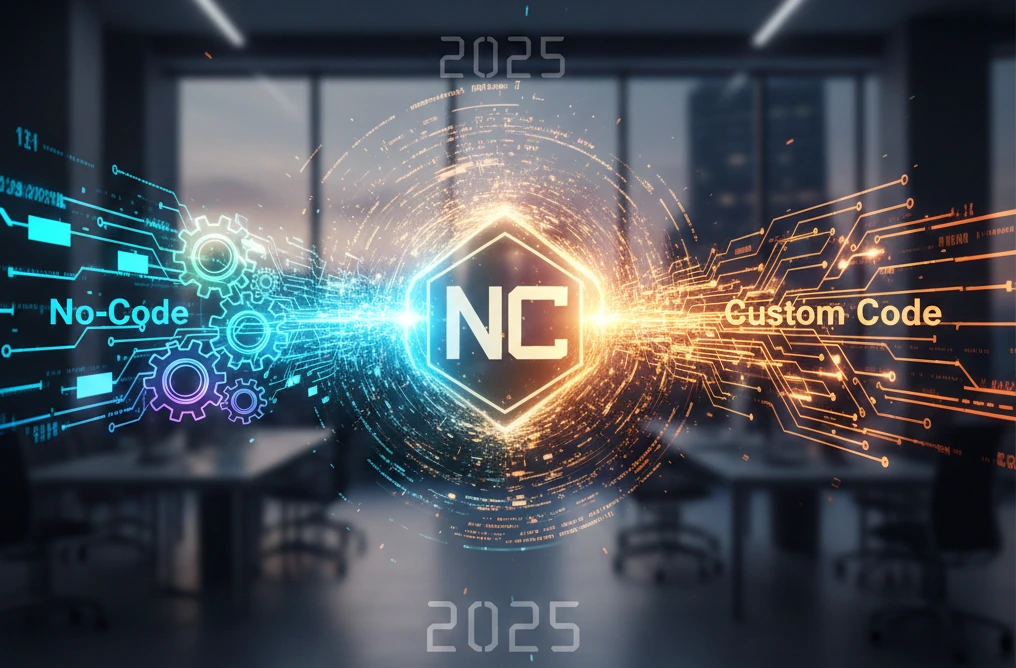
Startups in 2025 are operating in a hyper-competitive environment where speed, efficiency, and cost-effectiveness decide who wins and who disappears. Traditional app development is too slow and expensive for early-stage founders, while pure no-code tools can be limiting when an idea needs scale or custom functionality. This has led to the rise of the No-Code + Custom Code Hybrid Development Model — a smarter, faster, and more scalable way to build apps. In this blog, we explore why this hybrid approach is becoming the go-to strategy for modern startups.
What Is a No-Code + Custom Code Hybrid Model?
A No-Code + Custom Code hybrid development model combines the speed of no-code platforms with the flexibility of custom development. In 2025, this approach allows startups to use visual builders for foundational features—authentication, dashboards, workflows—while custom code handles complex logic, integrations, and scalability. Using a hybrid setup lets founders test ideas faster while ensuring the product can evolve into a powerful full-scale application. This balance is the main reason startups lean toward hybrid development today.
- Hybrid Model Definition
The hybrid approach merges visual development platforms with custom coding to achieve speed and scalability in a single workflow.
- Why It Matters in 2025
With market demands accelerating, startups need rapid iteration and long-term flexibility, making hybrid development essential.
Why Startups Prefer Hybrid Development in 2025
Hybrid development has become mainstream because it eliminates the trade-offs between speed and power. Startups love the reduced time-to-market, lower MVP costs, and ability to pivot quickly. Pure custom coding can take months and cost tens of thousands, while no-code can be too restrictive as a product grows. The hybrid model bridges the gap by offering fast prototyping with reliable long-term scalability.
- Faster Time-to-Market
Startups can launch MVPs in weeks instead of months by leveraging prebuilt components and rapid prototyping.
- Lower Upfront Costs
Hybrid development significantly reduces early development costs while maintaining technical robustness.
Real-World Use Cases Where Hybrid Approaches Win
Hybrid development excels in industries where speed matters but custom workflows are unavoidable — FinTech, SaaS, marketplace apps, ed-tech platforms, and logistics solutions. A marketplace MVP, for instance, can be built using no-code UI and workflows, while custom APIs handle matching, payments, or AI suggestions. This prevents limitations such as insufficient performance, security constraints, or lack of customization.
- Marketplace Apps
Hybrid development is ideal for marketplace MVPs that need fast UI building and strong custom backend logic.
- SaaS Platforms
Most SaaS MVPs begin with no-code dashboards and expand using custom-coded automations and integrations.
Cost Breakdown: Pure No-Code vs Custom Code vs Hybrid
In 2025, pure no-code MVPs typically cost between $3,000–$12,000, while custom-coded MVPs range from $25,000–$120,000 depending on complexity. Hybrid MVPs sit comfortably in the middle—$10,000–$45,000—because startups save time on UI and basic workflows while investing only in custom-built features that truly matter. This makes hybrid development a financially strategic choice for early-stage founders.
- No-Code Cost Range
Founders can launch simple no-code MVPs for as little as $3,000, making it extremely accessible.
- Hybrid Cost Benefits
The hybrid model reduces unnecessary engineering costs while focusing spending on important custom features.
How Long It Takes to Build a Hybrid MVP in 2025
Speed is where hybrid development shines. A pure custom-coded MVP may take 3–7 months, but hybrid MVPs often launch in just 4–10 weeks. This is because 50–70% of repetitive UI components and logic are handled by no-code frameworks, leaving developers to focus on unique product features and backend systems. This gives startups a significant competitive advantage.
- 4–10 Week Development Cycle
Hybrid MVPs typically launch in under 10 weeks due to automated UI and workflow generation.
- Less Engineering Overhead
Developers spend less time on repetitive tasks and more time building features that differentiate your startup.
Best Tools & Tech Stacks for Hybrid Development
The hybrid model thrives on selecting the right tools. Popular no-code builders include Bubble, FlutterFlow, Webflow, and Retool, while the most compatible custom stacks include Node.js, Firebase, React, Flutter, and serverless cloud functions. Combining these enables startups to build fast while keeping the door open for advanced scaling, performance optimization, and future microservices.
- Top No-Code Tools
Platforms like Bubble, FlutterFlow, and Webflow enable quick UI assembly with drag-and-drop workflows.
- Top Custom Stacks
Node.js, React, Flutter, and Firebase allow deep customization and high-performance scalability.
When Should a Startup Avoid No-Code?
Despite its advantages, no-code is not ideal for every situation. Apps requiring heavy real-time processing, high-performance 3D rendering, advanced AI models, or deeply custom backend infrastructure typically need full custom development. Startups building cybersecurity platforms, gaming apps, or complex enterprise SaaS may outgrow no-code quickly and should plan accordingly.
- When No-Code Fails
Apps requiring real-time data streaming or heavy processing often demand custom-coded architectures.
- Performance Constraints
Some no-code tools have limited optimization options, making them unsuitable for high-performance products.
The Future of Hybrid Development Beyond 2025
Hybrid development is expected to dominate the startup ecosystem for at least the next decade. AI-assisted builders, automated code generation, and smarter API integration tools will continue to increase the efficiency of mixed development workflows. Startups that embrace this model early will benefit from lower costs, faster iteration cycles, and strong product scalability.
- AI-Augmented Development
AI-driven no-code tools will generate more complex logic, making hybrid apps even faster to build.
- The Long-Term Outlook
Hybrid development will dominate innovation cycles by offering both speed and scalability.